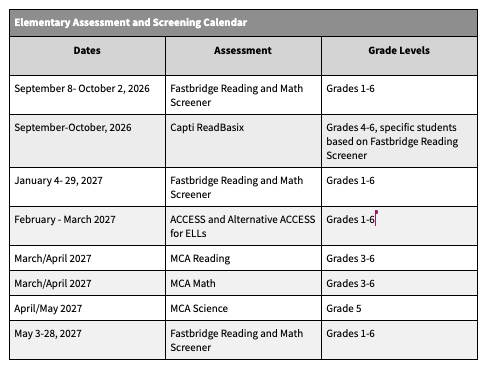
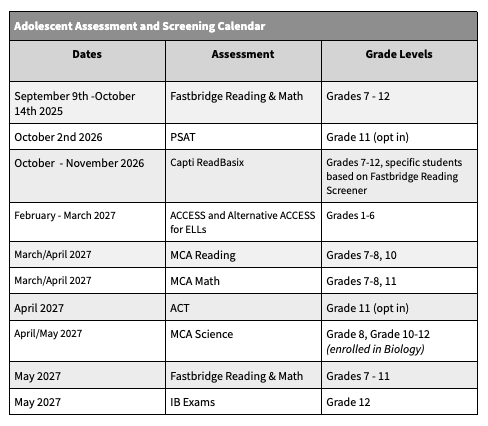
GRS Assessment Calendar Overview
For more information on each test, scroll down for descriptions under the tables below.
-
All students identified as English Learners (EL) will be taking the ACCESS or Alternate ACCESS assessment between January and March. This assessment is a federal requirement to assess English proficiency for students learning English. There are four domains tested - Reading, Writing, Speaking and Listening.
About ACCESS Testing
In order to follow federal and state mandates, all EL-identified students are given an English proficiency examination annually, even if they are not currently receiving English learner services. The test scores are used to make sure students are making progress in English through reading, writing, listening and speaking. The test is called the Assessing Comprehension and Communication in English State-to-State (ACCESS). This test helps teachers and schools understand how well students are learning English. The ACCESS test includes questions about reading, writing and listening. The test is taken in a group setting with other students and includes a speaking assessment between each student and a teacher. The test will not be timed.
Your child will be tested during the regular school day either on a computer (online) or on paper.
-
The ACT is a standardized test used by colleges and universities to evaluate college readiness. It measures skills in English, math, reading, and science, with an optional writing section. The results give students insight into their academic strengths and areas for growth while helping colleges understand their preparedness for higher education.
At our school, the ACT is part of our approach to supporting students’ college planning and readiness, providing guidance for goal-setting and future academic success.
-
Beginning in 2026, Great River School will administer the Capti ReadBasix as part of the Read Act requirements to Grades 4-12.Capti ReadBasix is part of the legislation known as the Minnesota Reading to Ensure Academic Development Act (READ Act), which focuses on ensuring all students receive the reading instruction they need to become confident, capable readers. Capti ReadBasix Screener is the tool approved by the Minnesota Department of Education to identify reading difficulties, including the characteristics of dyslexia.The assessment assesses six key areas:
Word Recognition and Decoding (Ability to recognize known words in print and link letters with their sounds to read new words)
Vocabulary (Vocabulary knowledge)
Morphology (Ability to identify and use various word parts)
Reading Efficiency (Ability to silently read text accurately and at an appropriate rate for understanding)
Sentence Processing (Ability to comprehend sentences of varying complexity)
Reading Comprehension (Ability to understand text)
The assessments will be taken over two days and will take no more than 75 minutes total.ParticipationFollowing the READ Act guidelines, students have been identified for the additional reading screener based on the following:
Grades 4-12: CBMReading Scores indicating High Risk
Students who did not take the test(s) used to identify candidates for the Capti may be selected to complete the Capti screener. Participation in Capti testing is important so that we have accurate data to assess how students are reading.
Learn more about the Screening Guidance for Grades 4-12 from the Minnesota Department of Education (MDE)
-
Fastbridge:
GRS uses Fastbridge assessments for universal screening and progress monitoring in reading and math skills for grades 1-12, to help teachers provide targeted instruction and interventions. GRS follows all READ Act Literacy Screening Requirements.
Purpose: FastBridge helps guides identify students who may need extra support in reading and math and is one way to show progress over time compared to same grade peers nationally.
Frequency:
In Grades 1-6, the assessments are administered three times per year (fall, winter, and spring).
In grades 7-12, the assessment is administered in the fall and spring
Subject areas: The assessments cover reading and math skills.
What it measures:
Reading: Foundational literacy skills such as letter names, sounds, decoding, vocabulary, and comprehension.
Math: Students' understanding of math skills
-
IB (International Baccalaureate) exams are the culminating assessments for students in the IB Diploma Program (IBDP). They evaluate knowledge, critical thinking, and skills across multiple subject areas, reflecting the depth and rigor of the program. IB exams also encourage students to demonstrate independent research, analytical reasoning, and clear communication.
At our school, these exams help seniors showcase their learning, earn the IB Diploma, and prepare for college and beyond, while highlighting their ability to tackle challenging, globally recognized coursework. -
Minnesota Comprehensive Assessments (MCAs):
Great River School administers the Minnesota Comprehensive Assessments (MCA) each year. Students who receive special education services and meet eligibility criteria may take the Minnesota Test of Academic Skills (MTAS) test as an alternative. Most students will take the MCA online during the school day.
About the MCAs
The MCAs assesses students’ knowledge of academic, grade-level standards in reading, mathematics, and science. The MCA assessment results are used by many people for multiple purposes. Some examples include:
High school students can use MCA results to skip remedial coursework at Minnesota State Colleges and Universities
Families use the data to track and understand their child/ren’s progress in learning grade-level standards.
Guides use the data to inform their instruction and assess student learning.
District and school staff members use the results to assess academic achievement trends over time and identify inequities across student groups.
The MN Department of Education uses MCA data as an academic indicator in the North Star accountability system. The system identifies schools and districts that need support to improve student outcomes, ensures that accountability indicators are publicly reported, and recognizes schools and districts that have implemented successful strategies.
Policymakers use results to identify gaps in services and programming needs within communities.
Participation in MCA testing is important so that we have accurate data to assess how students are progressing academic standards and determine which academic areas we need to improve instruction in.
We recognize that the MCA testing window overlaps with a number of religious observances and holy days. We are committed to honoring and being responsive to the needs of all families and students. Please contact your child’s Program Director if you have concerns or questions about school testing dates and times, needed accommodations, and/or your student’s participation in MCA testing.
The Minnesota Department of Education (MDE) has the following resources to learn more about the assessments:
Student Participation in statewide assessments
MCA Parent Fact Sheets
-
PSAT:
The PSAT (Preliminary SAT) is a standardized test that helps students practice and prepare for the SAT, a key college admissions exam. Beyond preparation, it provides valuable feedback on academic strengths and areas for growth in reading, math, and writing. High scores on the PSAT can also qualify students for the National Merit Scholarship Program and other recognition opportunities.
At our school, the PSAT is optional and part of our commitment to supporting students’ college readiness, helping them set goals, and providing tools to plan for future academic success.